


Saint Martin-de-Castillon
• Vaucluse (84750) • Population: 741 • Altitude: 486 m
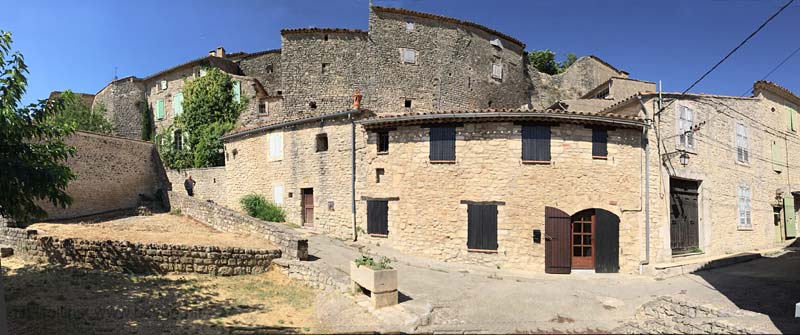
Gallery of 17 photos for Saint Martin-de-Castillon

 See map
St Martin-Castillon is an ancient little village on a small hill overlooking the wide valley between the Ventoux and Luberon mountains east of Apt, on the site of a 6th-century Monastery. The village has a good mixture of renovated and "more authentic" looking buildings, narrow streets circling the hillside and connecting walkways.
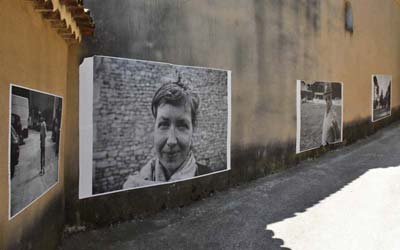 There's an artistic flavor to the village. When we visited in the summer of 2015, very large black-and-white photo posters were on many village walls; the subjects seemed to be people of the village.
Elephant of the Luberon
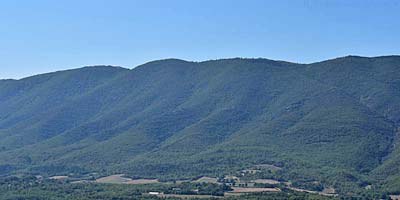 While we were in front of the Chapelle des Pénitents admiring the forested slopes of the Luberon mountains to the south, a gentleman explained to us what we were looking at but not seeing.
The crest of the mountains and the shadows of the valleys coming down the slopes has the shape (with a little bit of imagination) of a very large elephant, facing left. This is apparently a known sight, called The Elephant of the Luberon.
We see it (or at least we think we see it, therefore we think it's there); do you?
While we were in front of the Chapelle des Pénitents admiring the forested slopes of the Luberon mountains to the south, a gentleman explained to us what we were looking at but not seeing.
The crest of the mountains and the shadows of the valleys coming down the slopes has the shape (with a little bit of imagination) of a very large elephant, facing left. This is apparently a known sight, called The Elephant of the Luberon.
We see it (or at least we think we see it, therefore we think it's there); do you?
Sundials
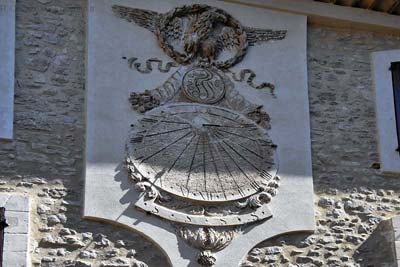 We only found one ancient sundial in St-Martin-de-Castillon, in the very center of the village at Place Murier. It's not very colorful, but it's big and rather unique with its engraved eagle motif.
History of Saint Martin-de-Castillon
Name
First record, 835 Abbatia Saint Martini
Prehistoric: A Neolithic oppidum de Courennes was a on a fortified site about 2 km northeast of the current village.
Medieval: A Benedictine Monastery was installed here in the 6th century and was once a fief of the Bishops of Apt. The original village of Castillon, located about 2 km to the east, was completely destroyed during the Wars of Religion. The inhabitants established their new village at its current location, where the Abbey of St Martin once stood.
Hiking
• GPS: 43.859578, 5.512554
Maps
IGN (1/25,000) #3343 OT "Greoux-les-Bains, Rians"
The GR11 (Grande Randonnée) hiking trail passes through St-Martin-de-Castillon village.
Only 3 km southwest the GR11 joins with the GR653 trail, part of the Chemin de St-Jacques de Compostelle. The GR653 passes along the base of the Luberon mountains, east past Céreste and northwest via Saignon village to Apt.
Dining
A Rare Bad Experience. St-Martin-de-Castillon has one café-bar, the Bar de la Fontaine, at the bottom of the village at the southeast corner. It claims to be a Bistrot de Pays, but that is patently false. A Bistrot de Pays is supposed to provide travelers with a good, local meal at a reasonable price, with good service. This barman here was extremely rude when we inquired about a lunch meal (which we did because the place was full of drinkers only), then ignored us for a half hour while serving regulars. The local, natural meal choices were: mixed salad (10 euros), beef tartare (raw), entrecote steak or pavé steak.
We left for the next village, of course. Our only poor experience on this trip, and a very, very rare poor experience in any of our Provence travels. The village of Viens is only a few minutes away, and our lunch experience there more than made up for any negativity here.
Transportation Saint Martin-de-Castillon
Department 84, Vaucluse Buses
- See Beyond's Bus Schedules Page 2: Vaucluse Department for downloading Vaucluse bus-lines map [Plan global des lignes] and bus-line schedules [pdf for each line] (link for PDF files).
• Avignon has train or bus connections to Aix-en-Provence, Arles, Nîmes, Saint Remy-de-Provence, Paris.
• Cavaillon has bus connections to Aix-en-Provence, Arles, Saint Remy-de-Provence.
• Pertuis has bus connections to Aix-en-Provence and Marseille.
 After 25 years online, I've decided to remove all Ads from my one-man web Provence Beyond. If the content is enjoyable or useful to you, I would really appreciate your support.